

Starting a Business in the Netherlands: How to Register a Dutch BV Remotely (Without the Headache)
The Entrepreneurial Leap: Dream vs. Administration
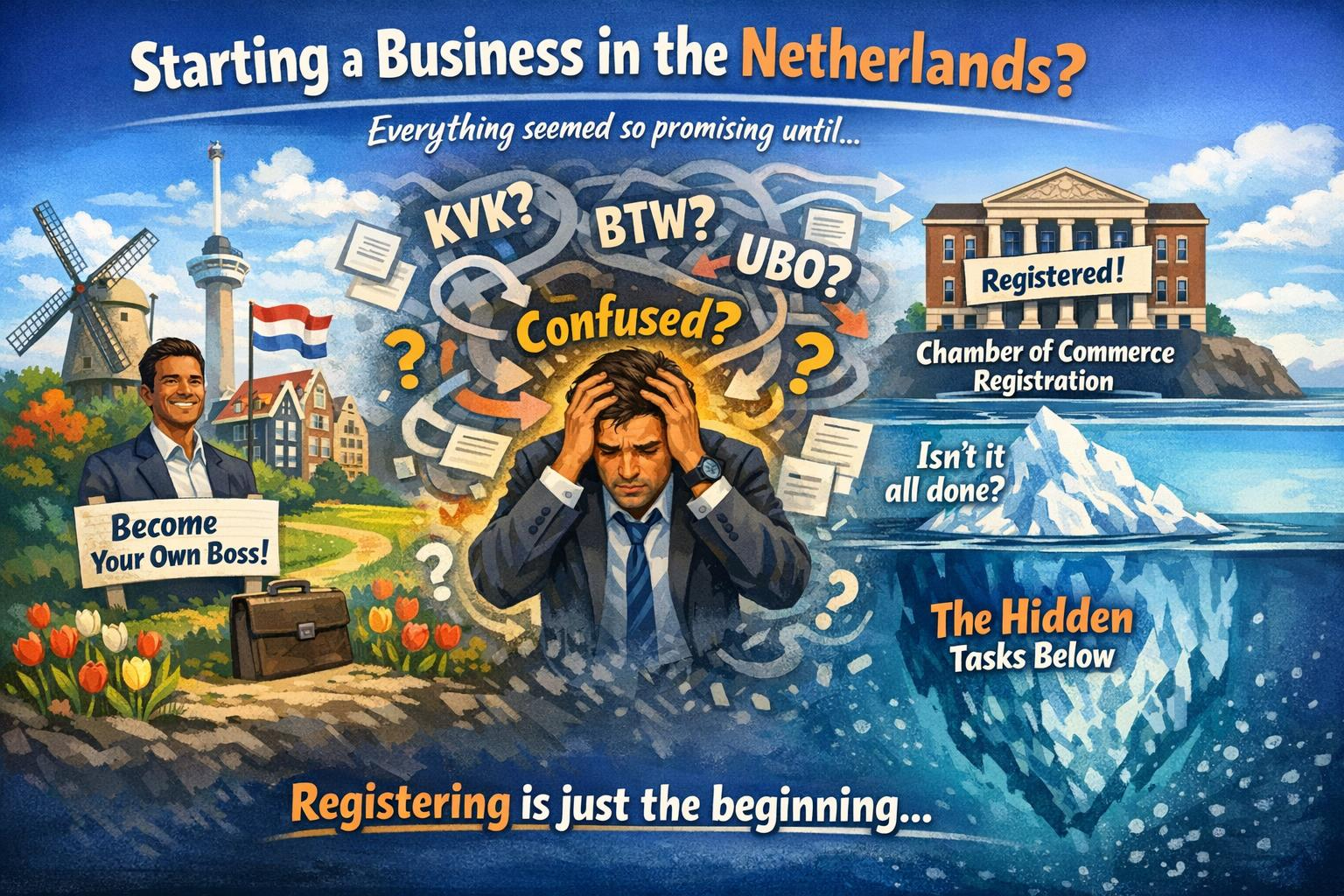
The Netherlands is widely recognized as one of the best places in Europe to start a business. With its strategic location, stable economy, and favorable tax treaties, it is a haven for startups and international entrepreneurs. You have the idea, the drive, and the market potential. You are ready to become your own boss in the land of tulips and tech hubs.
You finally found the courage to start your business, but it all seems too complicated?
This is the moment where the dream often collides with reality. You picture yourself pitching to investors in Amsterdam or shipping products from Rotterdam, but instead, you find yourself drowning in a sea of Dutch acronyms: KVK, BTW, UBO, DGA. The transition from “having an idea” to “having a legal entity” is rarely as smooth as the glossy brochures suggest.
The “KVK Illusion”
There is a common misconception that walking into the Chamber of Commerce (Kamer van Koophandel or KVK) is the finish line. In reality, it is just the starting gun.
Registering a business in the Netherlands seems like an easy process until you have to kick it off by yourself. Administration, corporate taxes, legal responsibilities, VAT number – everything requires attention and understanding.
Many entrepreneurs fall into the trap of underestimating the post-registration workload. They assume that once they have their KVK number, they can simply start selling. They don’t realize that a Dutch BV (Besloten Vennootschap – a private limited company) comes with specific obligations that a sole proprietorship (ZZP) does not.
For instance, are you aware of the “DGA salary” requirement? As a Director-Major Shareholder, the Dutch tax authorities expect you to pay yourself a specific minimum salary, which is taxed differently than dividends. Do you know how to file your quarterly VAT return if you have clients both inside and outside the EU?
When you are finally registered, most walk out thinking: “I am all set up, but I don’t know how to… (invoice clients, keep records, report to the tax office).” Information online does not let you keep focused on business matters and not on administrative questions.
Instead of focusing on product development or sales, you spend your nights Google-translating tax forms and worrying about compliance fines.
Case Study: Liam’s Remote Roadmap
To understand how complex—and ultimately how simple—this can be, let’s look at a recent client, Liam (name changed for privacy).
Liam is a software developer from South Africa with a growing client base in Europe. To serve his European clients effectively and present a professional corporate image, he needed a Dutch BV. However, Liam was still living in Cape Town and had a packed schedule. He couldn’t afford to fly to the Netherlands, stay in a hotel for a week, and visit a notary just to sign a few papers.
He tried to arrange it himself initially. He contacted several Dutch notary firms. The responses were discouraging:
- “You must be physically present for identification.”
- “We need all documents legalized and with apostille”
- “The process will take 8-10 weeks due to compliance checks on non-EU residents.”
Liam was stuck. He had contracts waiting to be signed by his new European entity, but the entity didn’t exist yet. The bureaucracy was threatening to kill his expansion before it started.
That is when he found UnitCity.
We explained to Liam that the traditional way is not the only way. Modern Dutch law allows for digital incorporation if handled correctly. We took over the process entirely. We coordinated with our partner civil law notary who specializes in international clients and expats. Liam identified himself via a secure video link. He signed the documents digitally.
Within 10 working days, Liam’s B.V. was a registered legal entity in the Netherlands. Liam didn’t have to leave his home office in Cape Town. He saved thousands of euros in travel costs and weeks of time.
The UnitCity Difference: Your Business Partner, Not Just a Service
Most agencies will just hand you the deed of incorporation and wish you luck. We operate differently.
At UnitCity, we don’t just help you register a company—we prevent any dilemmas and make sure it’s done right from the start.
We understand that for an expat or a non-resident, the legal system is a black box. Our goal is to make it transparent.
1. Truly Remote Incorporation
In a post-pandemic world, business shouldn’t be bound by geography. You do not need to visit any office to incorporate a Dutch BV—the registration through us is done completely online, including all notarial procedures.
This is a game-changer for digital nomads, international investors, and busy professionals. Whether you are in Amsterdam, New York, or Bali, the process remains the same.
2. Speed and Efficiency
Time is money. Traditional routes can drag on for months due to slow compliance checks and notary availability. You will have your business running within two weeks, with no bureaucratic waiting time. We pre-check all your documents before they go to the notary, ensuring a smooth “first-time right” process.
3. No Language Barrier
Dutch legal language is archaic and difficult even for locals. For foreigners, it is indecipherable. We talk with you in English and use simple terms to explain any complicated procedures. The incorporation documents and forms are also provided with translations to English. You will never sign a document you do not fully understand. We explain exactly what “statutes,” “shares,” and “liabilities” mean in your specific context.
4. Proactive Problem Solving
We go beyond any formal Dutch lawyer or KVK support—everything you haven’t thought of or didn’t know, we bring it up and solve it for you immediately.
For example, did you know that your BV needs a registered address? Or that you need to register “Ultimate Beneficial Owners” (UBOs) in a separate register? We don’t wait for you to ask; we guide you through these requirements proactively.
5. Global Inclusivity
Many Dutch banks and service providers are hesitant to work with non-EU nationals. We aren’t. We work with all nationals, passports, and foreign residents completely online, no differentiation in the process. Even if you are a non-Dutch resident. Your nationality should not be a barrier to your entrepreneurship.
Safety First: Compliance and Administration
The excitement of a new business often overshadows the boring reality of compliance. But mistakes here are costly. A wrongly filed tax form or a missed deadline can result in immediate fines from the Belastingdienst (Tax Authority).
Finally, we also help you prevent any mistakes on your administrative side and during the registration.
We assist you in setting up the correct structure from day one. We advise on:
- The 30% Ruling: If you are hiring yourself as an expat, can your BV apply for the 30% tax ruling for you?
- VAT (BTW): How to grant a VAT number after incorporation so you can start billing.
- Banking: Navigating the increasingly difficult landscape of opening a business bank account for a new BV with foreign owners.
Ready to Launch?
Don’t let the fear of paperwork kill your business idea. The Netherlands is waiting for your innovation, and the administrative hurdles are lower than you think—if you have the right partner.
Stop worrying about the forms you haven’t filled out and start focusing on the clients you want to sign.
Book a consultation with UnitCity and we will run you through all the information that the KVK doesn’t talk about.
Let’s get your Dutch business officially started.

Leave a Reply